
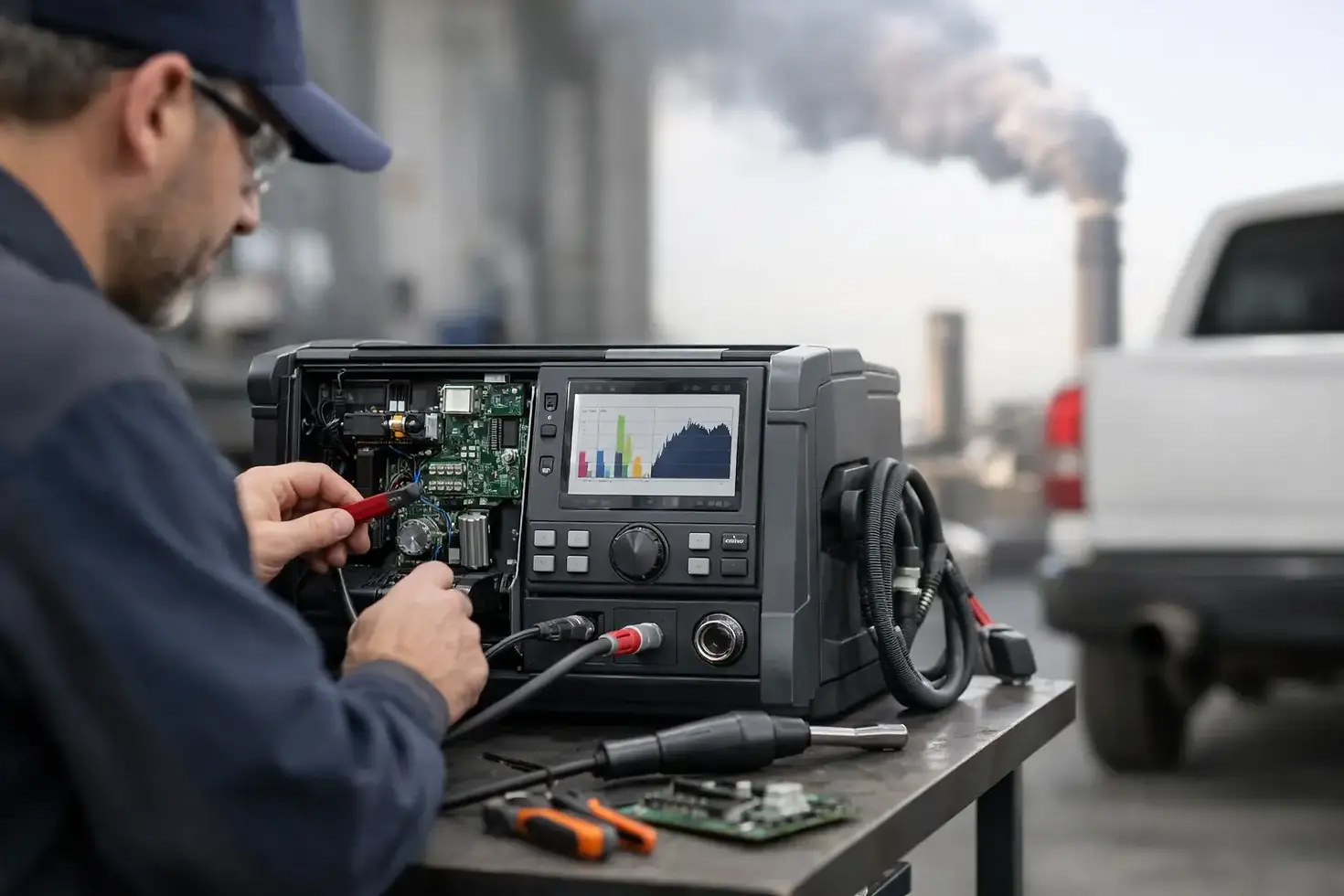
Emissions Analyzer Repair Services That Reduce Risk
A failed analyzer rarely waits for a convenient time. It shows up before a source test, during a compliance campaign, or in the middle of troubleshooting a permit limit excursion. When that happens, emissions analyzer repair services are not just a maintenance function. They are part of protecting data defensibility, field readiness, and regulatory confidence.
For industrial facilities, the issue is bigger than whether an instrument powers on and displays values. A repaired analyzer must return to service with stable response, verified calibration performance, and documentation that supports how the instrument will be used. If the repair is handled casually, the next problem may not be equipment downtime. It may be questionable emissions data, a failed audit trail, or a test program that has to be repeated under tighter timelines and higher cost.
What emissions analyzer repair services should actually cover
In emissions work, repair means more than replacing a worn component. Portable and fixed analyzers used for stack testing, combustion tuning, flue gas characterization, and compliance measurement operate in demanding conditions. Heat, moisture, particulates, vibration, sensor aging, and contamination all affect performance. A proper service process has to address both the hardware fault and the measurement integrity of the system after the fault is corrected.
That usually starts with inspection and diagnostics. Technicians need to determine whether the issue is isolated to a sensor, pump, valve, board, power supply, sample conditioning component, or communication pathway. In many cases, the symptom seen in the field is not the root cause. Slow response time may be a flow restriction. Drift may be related to contamination or temperature instability. Intermittent readings may come from internal connections rather than the sensing element itself.
After the fault is identified, repair should be followed by calibration, functional checks, and verification against expected instrument behavior. Depending on the analyzer type, that may include zero and span performance, leak checks, response time checks, linearity verification, and confirmation that the instrument meets the requirements of its intended method or application. If those steps are skipped, the instrument may be operational but still not suitable for compliance use.
Why repair quality matters for compliance programs
Facilities do not buy analyzer service for convenience alone. They need results they can defend. If an analyzer is used for relative accuracy work, periodic compliance testing, greenhouse gas measurements, or combustion diagnostics tied to permit conditions, questionable instrument performance creates exposure that extends beyond the maintenance budget.
Poorly repaired equipment can lead to biased readings, unstable baselines, failed calibration drift criteria, and incomplete field records. That affects decision-making in the moment. Operators may adjust combustion based on bad data. Environmental teams may submit reports built on readings that do not hold up under review. Engineering teams may spend time investigating process issues that are actually instrumentation issues.
This is why emissions analyzer repair services should be handled by technicians who understand the measurement context, not just the instrument model. The service provider needs to know how analyzers behave in stack testing environments, how method requirements affect acceptance criteria, and how field conditions can mask or magnify performance problems.
Common repair issues in emissions analyzers
A pattern appears across many repair requests. Electrochemical cells age and lose sensitivity. Infrared benches drift or suffer contamination. Pumps weaken and reduce sample flow. Solenoids stick. Moisture damage affects tubing, filters, connectors, and internal components. Battery and charging systems degrade with field use. Heated sample paths lose temperature control, which can create condensation and alter readings.
Software and communications issues also deserve attention. Analyzer repair is sometimes treated as purely mechanical or sensor-based, but data logging failures, firmware errors, display faults, and unstable communication ports can compromise chain of custody and reporting just as quickly as a failed pump. For facilities that integrate field instruments into broader emissions management programs, that matters.
There is also a practical distinction between a repair that restores temporary function and one that restores dependable service life. Replacing a failed part without checking related wear items can shorten the interval to the next failure. In regulated work, that kind of patch approach often costs more over time because it increases scheduling uncertainty.
When to repair and when replacement makes more sense
Not every analyzer should be repaired indefinitely. The right decision depends on instrument age, manufacturer support, parts availability, calibration stability, and the criticality of the analyzer to ongoing operations. If an instrument has recurring failures, obsolete components, or chronic drift that remains after service, replacement may be the better operational decision.
That said, replacement is not automatically the lower-risk path. New instruments still require setup, verification, user familiarity, and in some cases configuration to match existing procedures or reporting formats. A high-quality repair on a well-supported analyzer can be the fastest and most cost-effective way to maintain continuity, especially when a facility has established internal SOPs around that platform.
The best service providers will be direct about this trade-off. If a unit is repairable but no longer reliable for critical compliance work, that should be stated clearly. If a repair will restore full function with reasonable confidence, the scope and expected outcome should be defined just as clearly.
What to look for in emissions analyzer repair services
Industrial buyers should look beyond turnaround time alone. Speed matters, especially when testing windows are tight, but the value of repair depends on whether the analyzer comes back ready for defensible use.
Technical depth is the first requirement. The provider should understand combustion gases, stack sampling conditions, calibration protocols, and the operating behavior of the analyzer types used in emissions work. That background changes how diagnostics are approached and how final verification is performed.
Documentation is equally important. A professional repair record should identify the fault, the corrective action, replaced components where applicable, and the calibration or verification steps completed before return to service. For compliance-driven programs, this documentation supports internal quality systems and demonstrates that the facility treats measurement equipment with appropriate control.
It also helps when repair services are tied to a broader equipment support capability. If the same technical partner understands analyzer calibration, stack testing methods, field deployment, and equipment rentals, they can often solve problems with better context. In practice, that means fewer handoffs and less risk that an instrument is repaired in isolation from the work it needs to perform next.
Reducing downtime before it starts
The strongest repair strategy is preventive rather than reactive. Many analyzer failures begin as small performance changes that are easy to miss when crews are focused on production or testing schedules. Slower response, increased calibration adjustment, weak pump behavior, inconsistent warm-up, or abnormal moisture carryover are all early warnings.
Routine inspections, scheduled calibration checks, and periodic service intervals can catch these issues before they become field failures. Facilities with critical testing obligations should also consider backup planning. That may include spare sensors, replacement consumables, or access to rental equipment when a primary unit is down for service.
For facilities across emissions-intensive sectors, this planning step is often what separates orderly compliance execution from last-minute recovery. Air Research Group works with industrial clients that need both technical equipment support and emissions measurement confidence, and that combination is especially valuable when schedules are fixed by permit, audit, or reporting deadlines.
The repair process should support the next test, not just the last failure
A repaired analyzer should return to the field with a clear purpose. Will it be used for combustion optimization, screening, formal stack testing support, CEMS checks, or greenhouse gas measurement? The answer affects how the repair is validated and how the instrument should be prepared before deployment.
That is why good service does not stop at the bench. It accounts for the next operating environment, the gases to be measured, the expected concentration ranges, the sample handling setup, and the acceptance criteria that matter for the job ahead. A technically sound repair process protects more than the instrument. It protects schedules, personnel effort, and the integrity of emissions decisions.
When analyzer problems occur, urgency is real. But speed without verification is not a solution for regulated operations. The better approach is disciplined repair, calibrated return to service, and support from a technical team that understands exactly what is at stake when emissions data must stand on its own.


Comments