

Metro Vancouver Air Emissions Testing Requirements
- kevin0142
- 3 days ago
- 4 min read
A stack test that produces a number is not automatically a compliance test. For industrial facilities, Metro Vancouver Air Emissions Testing Requirements are typically defined by the authorization governing the source, the contaminant being measured, and the operating conditions under which the test is performed. A result is only defensible when the test plan, field work, analytical methods, calculations, and final report align with those requirements.
For plant managers and environmental teams, the practical issue is not simply scheduling a contractor. It is establishing a testing program that produces representative data, meets permit deadlines, and can withstand regulatory review.
How Metro Vancouver Air Emissions Testing Requirements Are Set
Metro Vancouver regulates many air contaminant discharges through its air quality management framework, including emissions permits and approvals issued for specified industrial sources. Requirements are facility-specific. The applicable authorization may identify emission limits, source-testing frequency, pollutants of concern, required test methods, production or fuel conditions, and reporting deadlines.
This means there is no universal annual stack-testing rule for every boiler, engine, process heater, kiln, or manufacturing exhaust system. One source may require periodic compliance testing every one, two, or five years. Another may require testing after commissioning, following a process change, or when requested by the regulator. Some facilities also have obligations under provincial or federal programs that must be coordinated with Metro Vancouver requirements.
The starting point should always be the current permit, approval, or other written authorization, including amendments and any regulator correspondence that changes a testing obligation. Older permits may contain legacy language, while modified equipment may trigger new conditions that have not yet been integrated into an established compliance calendar.
What a Defensible Compliance Test Usually Includes
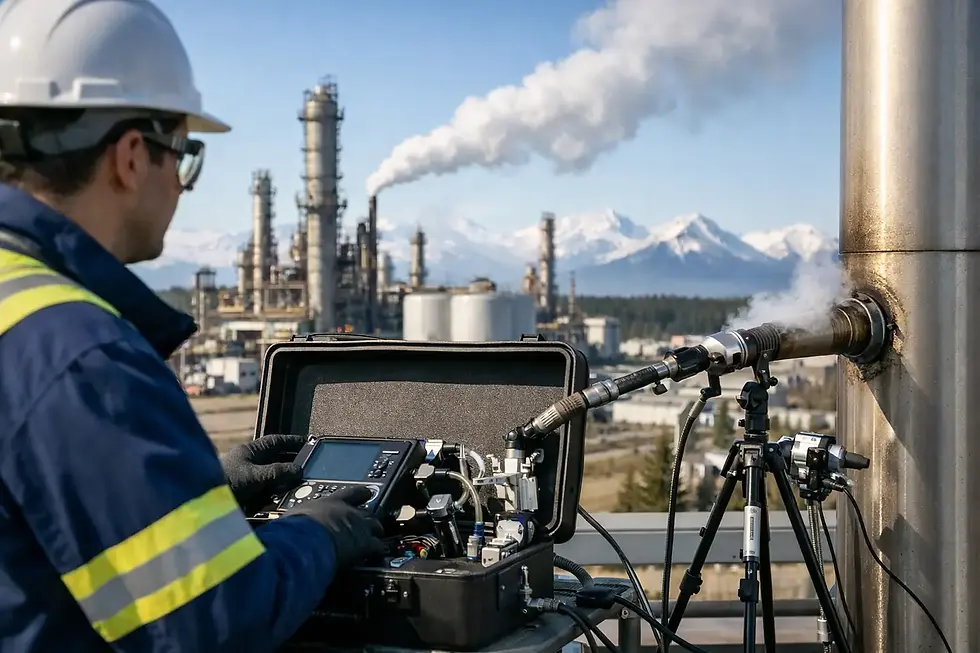
A compliant emissions test is a controlled measurement project, not a single field-day activity. Before mobilization, the facility and testing team need to confirm the emission points, contaminants, test methods, access conditions, normal operating range, and required number of runs.
Many authorizations reference recognized source-testing methods, often U.S. EPA methods or other accepted procedures. Depending on the source and pollutant, the scope may include particulate matter, nitrogen oxides, sulfur dioxide, carbon monoxide, volatile organic compounds, hydrogen chloride, hydrogen fluoride, metals, dioxins and furans, or other compounds identified in the permit.
The exact method matters. A test method defines sampling location criteria, traverse points, sampling duration, flow measurement requirements, quality-control checks, sample recovery procedures, and calculation approach. Substituting a convenient method or changing operating conditions without approval can create data that do not demonstrate compliance, even if the reported concentration appears favorable.
A complete program generally addresses four operational controls:
Safe, compliant access to sampling ports, platforms, power, lighting, and fall-protection points
Representative process operation, including documented production rates, fuel use, control-device status, and process parameters
Calibrated analyzers and sampling equipment with traceable quality-assurance records
A clear chain of custody and laboratory scope for collected samples
These controls protect both the test crew and the integrity of the final result. A test completed while a control device is bypassed, a boiler is at unusually low load, or a process is not operating normally may require qualification, retesting, or regulator discussion.
Permit Limits Are Not Always Reported the Same Way
A common compliance risk is comparing a laboratory or field result to a permit limit without confirming the required reporting basis. Limits may be expressed as concentration, mass emission rate, production-based rate, opacity, or another unit. They may also require corrections to a reference oxygen or carbon dioxide concentration, a specified temperature and pressure basis, dry gas conditions, or averaging periods.
For combustion sources, oxygen correction and fuel characterization can materially affect the reported result. For particulate and metals testing, flow rate and moisture measurements are essential to convert concentration data into mass emissions. For processes with variable production, the facility must document throughput accurately enough to support any production-normalized calculation.
Environmental managers should review draft reports for more than the pass-or-fail statement. Confirm that the test dates, source identifiers, operating data, methods, units, correction factors, calibration records, laboratory results, and comparison to each applicable limit are complete and internally consistent.
When Changes Trigger New Testing or Permit Work
Equipment modifications can change an emissions profile even when the physical stack remains the same. Examples include burner replacements, fuel changes, capacity increases, new pollution-control equipment, revised production processes, additional exhaust streams, and changes to hours of operation.
Whether a change requires a permit amendment, approval, engineering assessment, or post-change testing depends on the facility's authorization and the nature of the modification. Waiting until the next scheduled test can be risky if the change has already affected a permitted source or emission limit.
Early review is especially valuable for projects involving engines, boilers, heaters, combustion systems, cement-related operations, and process equipment with multiple pollutants of concern. The testing strategy may need to be designed around commissioning schedules, representative operating load, and required notice periods rather than added after startup.
Build Testing Into the Compliance Calendar
Stack testing should be coordinated with related obligations, including air permitting, NPRI reporting, greenhouse gas quantification, and applicable federal requirements such as MSAPR for affected electricity-generation sources. These programs do not use identical thresholds, methods, or reporting periods, but source-test data can inform several compliance decisions when it is collected and documented correctly.
Maintain a facility-level schedule that identifies each source, the governing authorization, testing frequency, report due date, operating conditions, and responsible internal contact. Include enough lead time to resolve access issues, obtain representative process conditions, and respond if retesting is required.
Before the next deadline, have the permit conditions reviewed against the actual equipment configuration and operating plan. That preparation gives the field team the information needed to execute safely and gives your organization emissions data that are useful beyond a single compliance submission.

Comments