

Metro Vancouver Asphalt Plant Emissions Testing Requirements
- kevin0142
- 3 days ago
- 4 min read
An asphalt plant can appear to operate normally while its emissions data tells a different story. Burner tuning, aggregate moisture, recycled asphalt pavement content, baghouse condition, and production rate can all change the gas stream and particulate loading. For facilities subject to Metro Vancouver Asphalt Plant Emissions Testing Requirements, a defensible testing program is not simply a field exercise. It is evidence that permit conditions are being met under representative operating conditions.
Start With the Permit, Not the Test Date
Metro Vancouver air quality requirements are generally applied through facility-specific permits, approvals, and applicable regional air quality bylaws. The controlling document is the permit issued for the site. It establishes the emission sources covered, contaminants of concern, applicable limits, testing frequency, operating conditions, notification requirements, and reporting deadlines.
Asphalt production facilities commonly need to evaluate emissions from sources such as aggregate dryers, drum mixers, batch plant exhaust systems, asphalt cement storage equipment, loadout operations, and associated combustion equipment. Depending on the permit and process configuration, required parameters may include particulate matter, nitrogen oxides, sulfur oxides, carbon monoxide, carbon dioxide, oxygen, total hydrocarbons, volatile organic compounds, and opacity.
A generic stack test scope is rarely sufficient. Before mobilization, environmental and operations teams should confirm the current permit revision, all source-specific conditions, and whether prior correspondence with the regulator has changed the required approach. Testing the wrong location, using an unapproved method, or operating outside the required production range can leave a facility with unusable compliance data.
Metro Vancouver Asphalt Plant Emissions Testing Requirements in Practice
A valid compliance test begins with a written plan that connects each permit condition to a sampling location, method, operating target, and reporting output. The plan should identify the test objective clearly: demonstrating compliance, establishing an emission factor, supporting a permit application, investigating an operational concern, or confirming control equipment performance.
Method selection must match the contaminant, stack configuration, and permit language. Commonly applied reference methods may include U.S. EPA methods for particulate matter, velocity traverses, moisture, molecular weight, oxygen and carbon dioxide, sulfur dioxide, nitrogen oxides, carbon monoxide, and volatile organic compounds. Where a permit specifies a method or method family, substitutions should not be assumed acceptable without regulator approval.
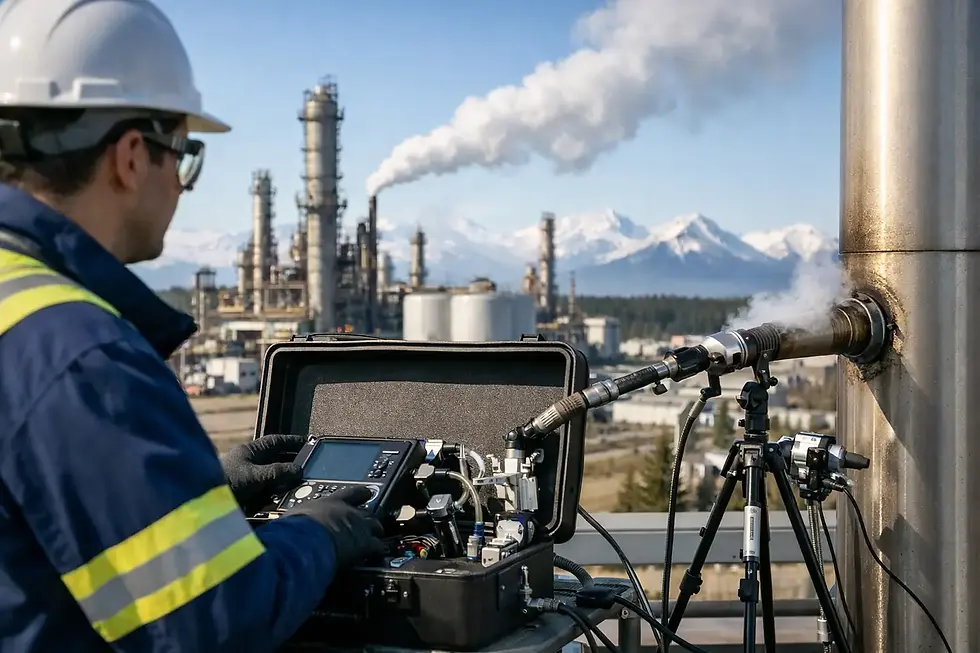
Sampling ports and platforms require equal attention. Representative sampling depends on suitable access, safe working conditions, adequate port dimensions, proper traverse points, and a flow profile that can support the selected method. A test crew cannot correct a poor stack design after arriving onsite. If sampling access is limited, a pre-test inspection can identify required modifications before the compliance deadline becomes urgent.
Representative Operation Is a Compliance Requirement
Asphalt plants do not produce uniform emissions at every operating point. A startup period, low-tonnage run, wet aggregate campaign, or reduced recycled asphalt pavement percentage may not reflect the conditions that produce the highest emissions. Permit conditions often require testing at normal maximum production, a specified production rate, or another defined operating scenario.
Operations personnel should document production rate, fuel type and consumption, aggregate moisture, mix design, recycled material percentage, burner settings, baghouse differential pressure, and any control-device adjustments during each test run. These records help demonstrate that the process was operating as required and provide essential context if results are reviewed by regulators or compared against future test data.
Testing should also be coordinated to avoid avoidable disruptions. A baghouse cleaning cycle, process upset, fuel switch, or unplanned maintenance event can invalidate a run or create results that do not represent standard operation. That does not mean a facility should conceal abnormal conditions. It means the testing team, plant operator, and environmental manager need a documented decision process when conditions change.
What a Defensible Testing Package Includes
A complete compliance deliverable should make it possible for a technical reviewer to trace every reported result back to field observations, calculations, calibrations, and quality-control checks. At a minimum, the record should include:
the approved test plan and any regulator correspondence;
process operating data and control-device operating records for each run;
field data sheets, calibration records, chain-of-custody documentation, and laboratory results;
sampling locations, traverse documentation, and method-specific quality-assurance data; and
emission calculations, permit-limit comparisons, deviations, and a signed final report.
The final report should state results in the same units and averaging basis used by the permit. A result can be technically correct but still difficult to assess if it is reported in incompatible units, excludes required oxygen correction, or does not identify the applicable production rate. Clear reporting reduces follow-up questions and supports internal compliance records, permit renewals, and future emissions inventories.
Prepare Before the Compliance Window Closes
The most effective testing programs are planned well ahead of the required due date. Permit review, method selection, regulator notification, site-access verification, laboratory coordination, and safe platform preparation all require lead time. This is especially true when an asphalt plant operates seasonally or has limited periods of stable, high-production activity.
Air Research Group Inc. supports facilities with compliance stack testing, flue gas characterization, air permitting, and equipment support that align field execution with reporting obligations. For an asphalt plant, the practical objective is straightforward: obtain accurate emissions data under representative conditions, document it completely, and retain a record that withstands regulatory review.

Comments