

Stack Emission Testing Fort McMurray Requirements
- kevin0142
- 4 days ago
- 4 min read
A missed test condition, an unrepresentative sampling location, or an incomplete report can turn a routine source test into a compliance issue. Stack Emission Testing Fort McMurray Requirements are not defined by a single checklist. They depend on the facility's approval conditions, emission sources, applicable provincial and federal programs, and the purpose of the data being collected.
For industrial facilities in the Regional Municipality of Wood Buffalo, a defensible program begins well before the field crew arrives. The testing scope must connect the operating process, pollutant limits, test methods, production conditions, and reporting obligations into one documented plan.
What Determines Stack Testing Requirements in Fort McMurray
Alberta industrial facilities commonly operate under approval, registration, or regulatory requirements that specify emission limits, monitoring frequencies, testing methods, and reporting timelines. The facility's environmental approval is the starting point. It may identify the sources to be tested, parameters to be measured, required load conditions, test frequency, and report submission requirements.
Common parameters include particulate matter, nitrogen oxides, sulfur dioxide, carbon monoxide, carbon dioxide, oxygen, volatile organic compounds, hydrogen chloride, hydrogen sulfide, metals, and selected organic compounds. The correct parameter list is source-specific. A natural gas-fired heater, diesel engine, combustion turbine, sulfur recovery unit, and material-handling source do not present the same measurement or compliance questions.
Federal obligations can also affect the testing program. Depending on the operation, facilities may require emissions data to support the Multi-Sector Air Pollutants Regulations, National Pollutant Release Inventory reporting, greenhouse gas reporting, or permit-related calculations. Testing data should be evaluated against these downstream uses before methods and detection limits are finalized.
Build the Test Plan Before Mobilization
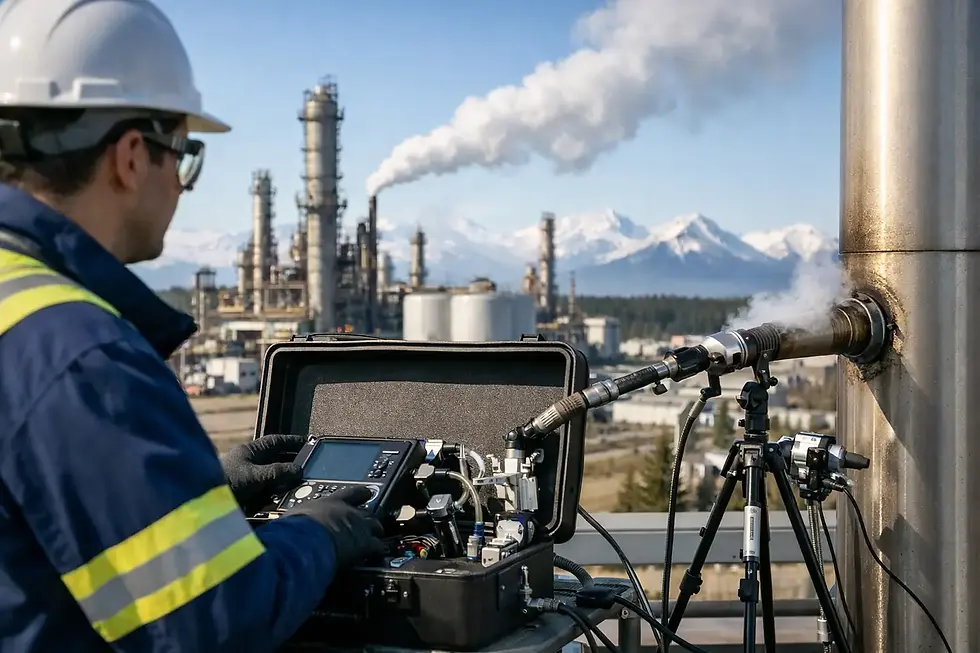
A compliant test is an engineered field project, not simply an analyzer reading at the stack. The test plan should establish the source configuration, sampling port condition, safe access, expected gas conditions, operating range, target pollutants, test methods, quality-control procedures, and deliverables.
EPA reference methods are frequently specified or accepted for source testing, including methods for velocity traverses, gas composition, moisture, particulate matter, sulfur dioxide, nitrogen oxides, carbon monoxide, and organic emissions. The appropriate method must be confirmed against the approval condition and regulator expectations. Substituting a convenient method without technical justification can create questions about comparability and compliance.
Operating conditions deserve particular attention. Many approvals require testing at normal maximum, representative, or specified production rates. If the unit is warming up, operating below load, cycling, bypassing a control device, or experiencing process instability, the resulting data may not represent the condition required by the approval. Record fuel type, throughput, control-device status, process load, ambient conditions, and relevant operating data throughout each run.
Sampling Location and Access Can Affect Data Quality
Representative sampling requires adequate ports, safe platforms, and a suitable upstream and downstream duct geometry. Flow disturbances, stratification, restricted access, insufficient ports, and unsafe work areas can compromise the test or require a variance, alternative approach, or engineering assessment.
This is especially relevant at operating facilities where stack modifications, insulation changes, ductwork alterations, or new control equipment have been installed since the last testing campaign. A pre-test site review can identify whether the existing location supports the required traverse points and sampling configuration. It also gives the facility time to address fall protection, lifting requirements, confined-space considerations, isolation procedures, and winter field conditions.
Quality Assurance Makes Results Defensible
Regulators and internal stakeholders need more than a final emissions number. They need confidence that the number was produced through controlled methods, calibrated equipment, documented field practices, and technically valid calculations.
A complete program should include pre- and post-test calibrations, leak checks where applicable, analyzer zero and span records, sample-chain documentation, field data sheets, laboratory analytical results, process operating records, and review of calculations and units. Detection limits and reporting limits must be appropriate for the applicable emission limit or inventory threshold. A result reported below an unsuitable detection limit may not satisfy the intended compliance purpose.
When continuous emissions monitoring systems are used, periodic relative accuracy testing, calibration support, and correlation with source-test data may be required by the applicable program. Stack testing and continuous monitoring should be planned as connected compliance activities rather than separate projects.
Reporting and Follow-Up Requirements
The final report should clearly state the tested source, dates, methods, operating conditions, sampling configuration, quality-control results, emissions calculations, and comparison to the applicable limit or reporting basis. Supporting appendices should make the work auditable without forcing the reader to reconstruct the field program from summary tables.
If results approach or exceed a limit, prompt technical review is necessary. The next steps may include verifying calculations, assessing test validity, reviewing combustion or control-device performance, identifying operating contributors, and determining notification or retesting obligations. Retesting without addressing the underlying process issue can waste time and leave compliance exposure unresolved.
For facilities managing multiple combustion sources or planned maintenance outages, an annual emissions calendar is often more reliable than scheduling tests only when a deadline approaches. Coordinating source testing, equipment calibration, permit obligations, NPRI data collection, and greenhouse gas calculations helps prevent duplicated work and produces emissions data that can stand up to regulatory review.

Comments