
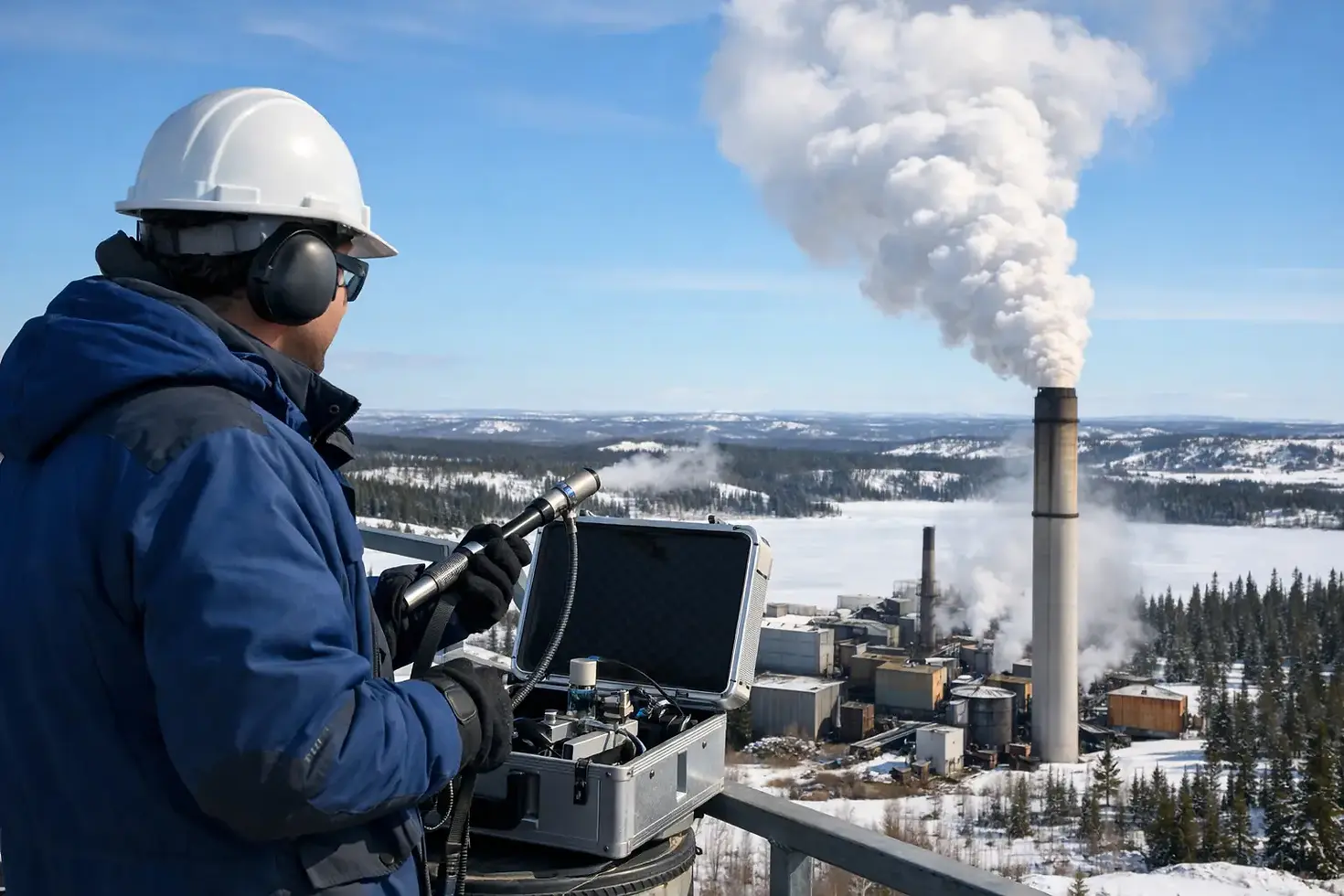
Stack Emission Testing in Northwest Territories
- kevin0142
- 54 minutes ago
- 6 min read
A missed test window in the Northwest Territories can affect far more than a reporting deadline. It can delay an operating approval, leave a facility without current compliance evidence, or force a return mobilization under far less favorable weather conditions. Stack Emission Testing Northwest Territories operators require must therefore be planned as a controlled technical project, not treated as a routine site visit.
For industrial facilities with boilers, heaters, engines, thermal processes, generators, incineration equipment, or other combustion sources, a valid emissions test begins well before the field crew arrives. The final data must represent normal operations, meet the applicable method requirements, and stand up to regulatory review. Northern access, winter conditions, and limited local support make that discipline even more consequential.
What makes stack testing different in the Northwest Territories
The core principles of compliance testing do not change by latitude. Sampling locations must be suitable, test ports must be safe and accessible, operating conditions must be documented, calibrated instruments must be used, and the selected method must match the required pollutant and source condition. What changes is the margin for error.
Remote mobilization can involve air travel, seasonal roads, long distances between facilities, limited freight options, and restricted access to replacement parts or specialty gases. A missing probe liner, damaged heated line, or incorrect calibration gas concentration can disrupt a test program that took weeks to coordinate. Facilities should treat equipment readiness and shipment planning as part of compliance management, rather than field logistics alone.
Cold weather also affects both safety and data quality. Sample lines, impingers, pumps, gas conditioning systems, and analyzer enclosures may require heat tracing or protected staging to prevent freezing and condensation. Personnel working on elevated platforms need a site-specific plan for wind, ice accumulation, restricted visibility, fall protection, communications, and emergency response. Testing should be deferred when conditions prevent safe access or compromise method requirements. Producing questionable data is not a substitute for completing a valid test.
Start with the approval and reporting obligation
The first question is not, “When can testing be scheduled?” It is, “What exactly must this test demonstrate?” Approval conditions, permits, federal programs, environmental agreements, and internal emissions commitments can each establish different testing, monitoring, or reporting expectations.
A facility may need source testing to confirm a concentration limit, determine a mass emission rate, establish an emission factor, support an air permit application, verify control equipment performance, or provide inputs for greenhouse gas and NPRI reporting. Those objectives may overlap, but they are not interchangeable. A test designed only for a one-hour concentration result may not supply the production, fuel, moisture, oxygen, or flow information needed to calculate a reliable annual inventory.
Before mobilization, the facility and testing team should confirm the regulated source, pollutants, emission limits, averaging periods, required operating load, test frequency, reference methods, report format, and notification requirements. If an approval names a specific method or protocol, that requirement takes precedence unless the regulator has accepted an alternative in writing.
For many combustion sources, the program may use recognized EPA reference methods or equivalent approved procedures. Typical examples include Methods 1 through 5 for traverse selection, velocity, flow, gas composition, and particulate matter, as well as methods for sulfur dioxide, nitrogen oxides, carbon monoxide, hydrogen chloride, metals, or dioxins and furans when applicable. The appropriate method depends on the source, pollutant, gas matrix, expected concentration range, and regulatory requirement.
A defensible test starts with a pre-test assessment
A pre-test assessment identifies problems while they can still be corrected without putting a schedule at risk. It should review drawings, prior stack test reports, source operating data, stack dimensions, port orientation, platform layout, electrical availability, access routes, and safety requirements.
Sampling location is one of the most common constraints. A stack may have ports that are difficult to reach, too close to a disturbance, improperly sized, or unsuitable for the traverse required by the selected method. In some cases, an engineering review can identify a workable alternative sampling plane. In others, the facility may need to install new ports or modify the platform before a representative test can proceed.
The testing plan should also define what “normal operation” means for the source. For a boiler, that may include a stable firing rate, routine fuel, normal air-to-fuel control, and typical pollution control configuration. For an engine, it may involve a defined load and fuel quality. Testing at an unusually low load, during startup, or while a control device is bypassed can invalidate the usefulness of results, even if the field procedures themselves were performed correctly.
Facilities should identify the operating data that must be recorded during each run. Fuel flow, fuel characteristics, production rate, steam output, electrical load, control device parameters, fan settings, oxygen, and process temperatures often provide the context needed to interpret results. Without that information, a report may show a compliant number while offering little explanation of whether the test represented normal operations.
Field execution requires method control and site coordination
During a compliance test, small procedural details can have large consequences. Sampling trains must be assembled correctly, leak checks must meet the method criteria, calibration records must be complete, and field data must be legible and traceable. For isokinetic particulate testing, the team must maintain the required sampling relationship to stack gas velocity. For instrumental methods, calibration gases, analyzer response, drift checks, and conditioning systems must be controlled throughout the test.
Facility personnel play an essential role. Operators should be available to maintain stable source conditions, communicate planned changes, document process parameters, and respond if equipment performance deviates from the agreed test plan. The test crew should have a clear point of contact for permits, isolation requirements, access, site inductions, and weather-related decisions.
This coordination is particularly important when testing multiple sources during a limited site visit. A practical schedule accounts for warm-up time, analyzer calibration, test run duration, equipment moves, sample recovery, and contingency time. Trying to compress these activities to recover a delayed start can increase safety exposure and create avoidable quality issues.
Results need technical review before they become compliance decisions
A final stack test report is more than a table of concentrations. It should document the source, operating conditions, methods, sampling locations, calibration information, quality-control checks, calculations, laboratory analyses where applicable, and deviations from the approved plan. It should clearly state units and reference conditions, including whether values are corrected to dry gas, standard conditions, oxygen content, or another required basis.
This distinction matters. A measured concentration can appear low but exceed a limit after oxygen correction. Similarly, a concentration result may comply while the calculated mass rate exceeds a permit threshold because stack flow is higher than expected. Environmental managers should review both the reported result and the calculation basis before using the data in regulator correspondence, annual reports, or internal performance decisions.
When results are near a limit, the next step should not be an assumption that the source has failed or passed. Review source operating stability, measurement uncertainty, test method applicability, laboratory findings, control equipment performance, and any documented field deviations. A technically sound assessment can distinguish a true emissions issue from an operational anomaly or a data-quality concern that requires clarification.
Build stack testing into the annual compliance calendar
The strongest programs do not wait for an approval deadline to start planning. They establish a yearly testing calendar that aligns regulatory due dates with expected production cycles, seasonal access, maintenance outages, and facility staffing. For remote northern sites, early planning also improves access to calibrated equipment, specialty sampling media, laboratory capacity, and qualified field personnel.
Testing data should feed the larger air compliance program. A result may support permit renewals, NPRI threshold assessments, greenhouse gas calculations, emission inventories, control equipment evaluations, and operating decisions. Where continuous emissions monitoring or portable analyzer checks are used, periodic source testing can provide a valuable independent reference point, provided the comparison is technically appropriate.
Air Research Group approaches this work as a combination of field measurement, engineering judgment, and compliance documentation. The practical objective is not simply to collect a sample. It is to produce accurate, traceable emissions data that a facility can use with confidence.
For Northwest Territories facilities, the most reliable path is to confirm the compliance objective early, verify that the stack and platform can support the required method, plan around northern conditions, and protect enough time to perform the work correctly. That preparation turns a difficult mobilization into defensible information for the people responsible for operating the source and reporting its emissions.


Comments