

Turbine Emission Testing for Compliance Plans
- kevin0142
- 4 days ago
- 4 min read
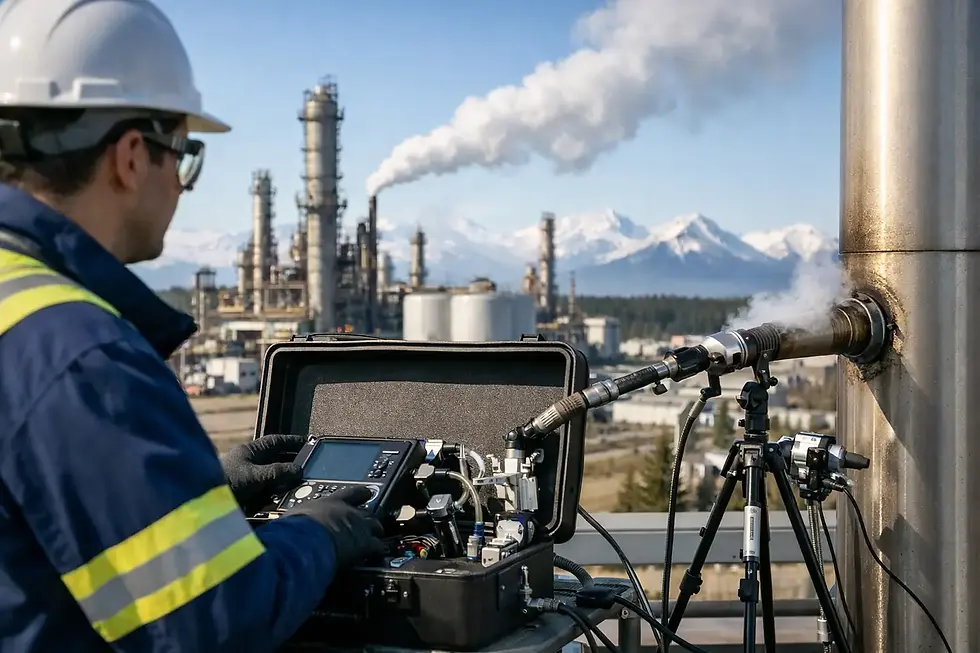
A turbine can operate reliably while its emissions profile drifts beyond permit limits. Changes in fuel quality, ambient conditions, water or steam injection, load cycling, combustion tuning, and catalyst performance can all affect measured results. Turbine Emission Testing for Compliance provides the defensible field data needed to demonstrate performance, support required reporting, and identify issues before they become enforcement or operating risks.
For facility owners and environmental managers, the objective is not simply to obtain a test report. It is to complete a safe, representative, method-compliant test program that answers the regulator's question and produces data that can withstand review.
What a compliant turbine test program must establish
Stationary combustion turbines are commonly subject to limits or reporting requirements for nitrogen oxides (NOx), carbon monoxide (CO), carbon dioxide (CO2), oxygen (O2), sulfur dioxide (SO2), volatile organic compounds, particulate matter, or greenhouse gas emissions. The applicable parameters depend on the unit, fuel, control technology, operating permit, provincial or federal requirements, and the purpose of the test.
A valid result begins with identifying the correct compliance basis. Some permits require concentration limits corrected to a defined oxygen reference, while others apply mass emission limits, heat-input-based limits, or seasonal operating restrictions. A test program must account for the exact averaging period, units, correction equations, operating load, fuel specification, and test frequency stated in the authorization or regulatory framework.
Testing at the wrong load, using an incorrect oxygen correction, or overlooking a permit-specific calculation can create a result that is technically measured but unsuitable for compliance demonstration. This review should occur well before mobilization, not after field data have been collected.
Planning turbine emission testing for compliance
Pre-test planning is where most avoidable issues are eliminated. The facility and testing team should confirm the turbine's normal operating range, expected load during testing, control system configuration, fuel source, exhaust stack access, and any recent maintenance or tuning activities. If selective catalytic reduction, oxidation catalyst systems, or water injection are installed, their operating status and relevant process parameters should be documented.
The sampling location also requires careful review. Exhaust stacks on turbines may present high temperatures, elevated velocities, limited access, restricted clearances, or non-ideal flow conditions. A site assessment helps determine whether the available ports, platforms, power supply, lifting requirements, and safety controls support the selected reference methods.
For many turbine applications, instrumental methods are used to measure gaseous pollutants and diluent gases. Method selection may involve applicable EPA reference methods, continuous emissions monitoring system procedures, or permit-approved alternatives. The governing method should be established in writing, including calibration requirements, sampling duration, number of runs, quality assurance checks, and data acceptance criteria.
Representative operating conditions matter
Regulators generally expect compliance testing to reflect the operating conditions specified by the permit or the conditions under which emissions are highest. That may mean testing at base load, a defined percentage of rated capacity, a minimum stable load, or a seasonal operating mode. A turbine held at an unrepresentative condition solely to achieve a favorable result can undermine the defensibility of the program.
Plant operations should stabilize the unit before formal runs begin. The test team should record operating data such as megawatt output, fuel flow, exhaust temperature, ambient temperature, inlet air conditions, water or steam injection rate, control device parameters, and fuel composition where relevant. These records provide the context required to explain the measured emissions result.
There are legitimate cases where a unit cannot achieve its prescribed test load because of grid dispatch, process demand, equipment limitations, or safety restrictions. When that occurs, the deviation should be evaluated before testing proceeds. It may require regulator notification, a revised test plan, or a clearly documented explanation in the final report.
Field quality assurance protects the result
Emission testing is only as defensible as its quality control. Analyzer calibrations, system bias checks, drift checks, leak checks, run times, sample conditioning, and chain-of-custody practices must follow the approved method and project plan. Field personnel also need to recognize conditions that can affect data quality, including moisture condensation, analyzer interference, unstable turbine load, poor probe placement, or insufficient sample flow.
Safety is equally integral to data quality. Turbine exhaust testing can involve elevated work platforms, hot surfaces, high noise levels, energized equipment, confined work areas, and changing weather conditions. A properly planned program coordinates site orientation, hazard assessments, fall protection, access controls, communications, and operating boundaries before personnel approach the stack.
Turning test data into compliance-ready reporting
The final deliverable should do more than list analyzer readings. A compliance-ready report clearly identifies the tested source, test dates, operating conditions, approved methods, calibration results, run-by-run data, calculations, oxygen corrections, averaging procedures, deviations, and final comparison against applicable limits.
This level of documentation supports permit submissions, internal environmental records, audit preparation, emissions inventories, and future planning. It can also reveal trends that matter operationally. A gradual rise in NOx, for example, may point to combustion tuning needs, degraded controls, altered fuel characteristics, or changing inlet conditions before a formal exceedance occurs.
For facilities with recurring obligations, the most reliable approach is to treat testing as part of an annual compliance calendar. Confirm requirements early, preserve prior test records, schedule access and operations support, and resolve method questions before the testing window becomes urgent. Air Research Group applies this disciplined approach to help industrial facilities obtain accurate measurements and compliance documentation that are ready for technical and regulatory review.

Comments