
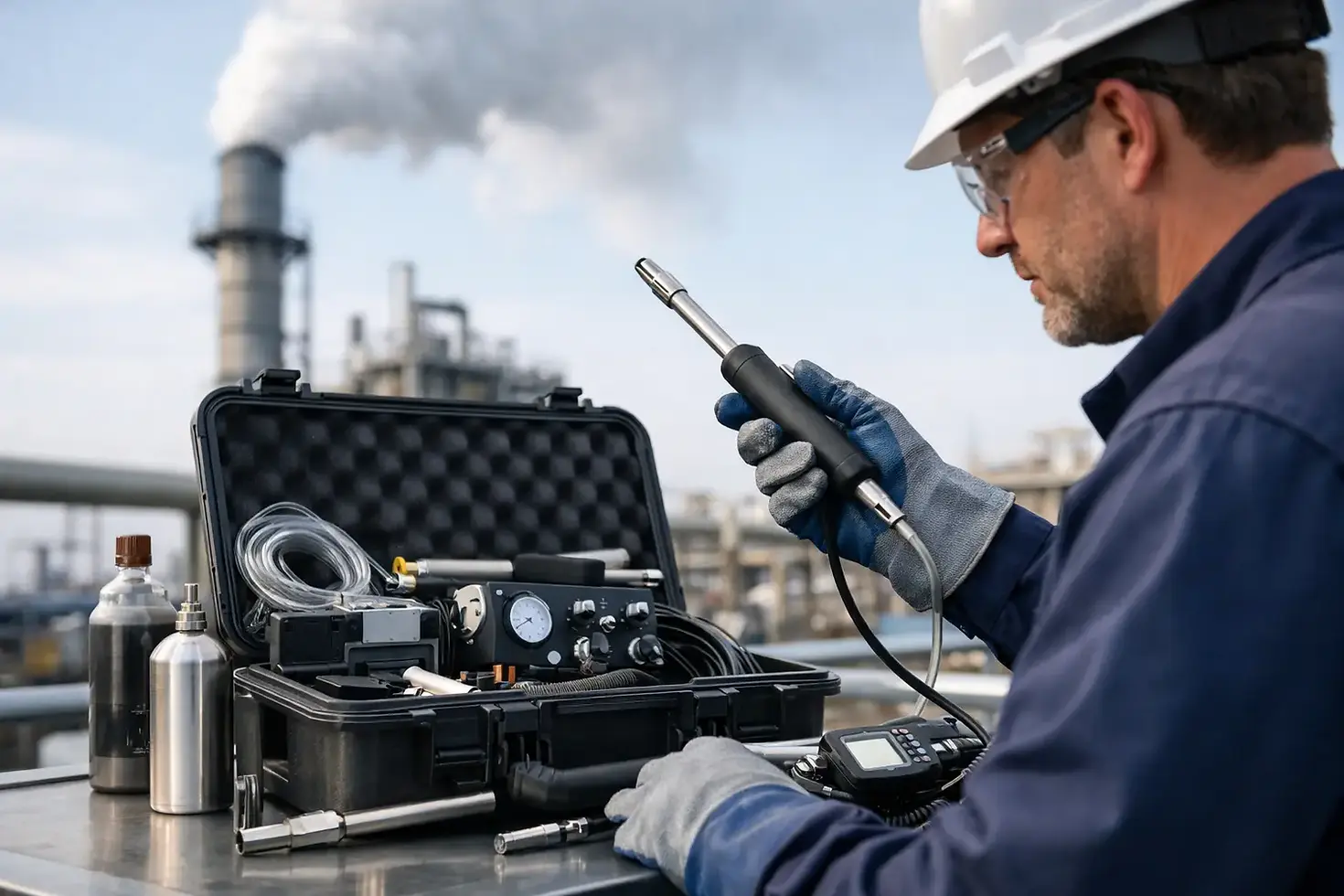
How to Select Stack Sampling Equipment Safely
- kevin0142
- Aug 3
- 6 min read
A stack test can be compromised long before the sample reaches the laboratory. An incorrect nozzle material, undersized pump, unsuitable probe length, or poorly matched analyzer can introduce bias, create unsafe field conditions, and leave a facility with data that cannot support a permit, report, or compliance decision. To select stack sampling equipment properly, start with the approved method and the actual conditions at the source, not a generic equipment list.
For plant managers, EHS leaders, and engineering teams, equipment selection is a measurement decision. The system must collect a representative sample while maintaining the temperatures, flow conditions, and contamination controls required by the applicable method. It also needs to be practical for the stack location, available ports, crew access, and test window.
Start With the Compliance Objective
The first question is not which sampler or analyzer to buy or rent. It is what decision the measurement must support. Compliance testing, permit confirmation, greenhouse gas reporting, process troubleshooting, and continuous emissions monitor verification can require different methods, detection limits, and quality-control procedures.
A test performed under an EPA reference method, a provincial approval condition, or a federal reporting program must follow the equipment configuration specified or allowed by that program. For example, particulate matter testing may require an isokinetic train with a properly sized nozzle, heated probe, filter assembly, impingers, and calibrated dry gas meter. A gaseous pollutant test may instead depend on a heated sample line, sample conditioning system, and analyzer configuration appropriate to the target compounds.
Review the governing requirements before defining the equipment package. That review should identify the target pollutants, expected concentration range, moisture and oxygen requirements, required averaging period, reference conditions, and reporting units. If the facility is near a reporting threshold, the detection capability and uncertainty of the selected method deserve particular attention.
Match the Equipment to Source Conditions
Stack sampling equipment must work under real process conditions, which are often less forgiving than a specification sheet suggests. Temperature, pressure, moisture, gas composition, particulate loading, velocity profile, and access constraints all affect what can be used and how it must be configured.
Temperature, moisture, and corrosive gases
Hot, wet gas streams are a common source of sampling error. If a sample cools below its dew point before collection or analysis, water can condense and absorb soluble gases. This can understate pollutants such as sulfur dioxide, hydrogen chloride, ammonia, or certain metal compounds, depending on the method and train design.
Heated probes, heated filter boxes, heated lines, and controlled sample conditioning are selected to preserve sample integrity where required. The temperature setpoint must be high enough to avoid condensation but compatible with the method, materials, and analyzers involved. Excessive heat can also affect sample components or damage seals, filters, and tubing.
Material compatibility matters just as much. Stainless steel is suitable for many applications, but it is not universally appropriate. Acid gases, high chlorides, reactive compounds, and elevated temperatures may require glass, quartz, fluoropolymer-lined components, specialty alloys, or method-specific sampling media. The wrong wetted material can corrode, react with the sample, or contribute contamination.
Flow, velocity, and particulate loading
For particulate methods, representative collection frequently depends on isokinetic sampling. The sampling nozzle, probe, pitot tube, differential pressure measurement, console, and meter calibration must work together to maintain the correct sampling rate as stack conditions change.
This is why nozzle selection is not a minor setup detail. Nozzle diameter is chosen using preliminary velocity, temperature, moisture, and anticipated sampling-rate information. A nozzle that is too large or too small can make it difficult to maintain isokinetic conditions within method tolerances. Facilities should also plan for spare nozzles and clean, protected components when ash, dust, or sticky particulate is expected.
High particulate loading may require more frequent filter changes, larger recovery capacity, or shorter run durations. It can also affect the safe placement of equipment and the ability to maintain a stable sample path. A technically correct train that cannot be serviced safely at elevation is not an operationally sound selection.
Select Stack Sampling Equipment by System, Not Component
A sampling train is an integrated measurement system. Buying a pump, analyzer, probe, or console independently can create compatibility gaps that appear only during mobilization or field testing. The better approach is to confirm the complete sample path from the stack to the final measurement.
For manual source testing, that path may include the nozzle, probe, heated or unheated liner, filter housing, impinger train or sample-conditioning assembly, pump, flow-control components, meters, temperature sensors, pressure sensors, and sample recovery materials. For instrumental methods, it can include the probe, heated line, conditioning equipment, analyzer, calibration gases, data acquisition system, and emissions calculations.
Each component must be rated for the intended conditions and compatible with the others. A high-quality analyzer does not correct a poorly conditioned sample. Likewise, a properly configured sample train cannot produce defensible results if critical instruments are outside calibration or if data acquisition does not capture the required parameters.
Before procurement or rental, verify these system-level questions:
Does the configuration meet the method's prescribed design and performance criteria?
Are all wetted surfaces compatible with the source gas and target analytes?
Can the system operate across the expected temperature, pressure, and moisture range?
Are calibration standards, spare consumables, and replacement parts available for the planned test duration?
Can the equipment be transported, assembled, grounded, and operated safely at the sampling location?
Do Not Treat Calibration as a Final Check
Calibration is part of equipment selection because it determines whether the equipment can support traceable, defensible data. Differential pressure gauges, thermocouples, dry gas meters, pitot tubes, balances, timers, pumps, and analyzers all require appropriate calibration and maintenance intervals.
The required accuracy varies by method and parameter. A device that is acceptable for preliminary process diagnostics may not be adequate for a regulated compliance test. Confirm that calibration certificates are current, traceable to recognized standards where applicable, and available for the final test record.
Analyzer selection requires additional attention to zero and span checks, interference testing, response time, drift criteria, and sample conditioning. For combustion sources, oxygen and carbon dioxide measurements may be needed for corrections to reference oxygen or dry conditions. The analyzer range should cover expected concentrations without sacrificing resolution at low levels. Selecting an excessively broad range can make low-concentration compliance results less meaningful.
Field checks are equally necessary. Leak checks, pitot leak checks, meter checks, pre- and post-test calibrations, and recovery checks should be planned into the work scope. Equipment that cannot accommodate these quality-control steps efficiently can increase field time and the likelihood of procedural deviations.
Account for Access, Utilities, and Safety Before Test Day
Many equipment problems are actually site-readiness problems. A complete selection process considers the test port configuration, platform dimensions, weather exposure, electrical supply, lifting requirements, lighting, fall protection, and distance between the stack and the ground-level work area.
Long sample lines can affect response time, heat retention, and pressure drop. Limited electrical service may require generators, intrinsically safe equipment, or alternative power planning. Elevated platforms may restrict the size and weight of consoles, cylinders, and recovery glassware that can be safely moved into position.
For sources with combustible gases, hazardous-area classification must be reviewed before equipment is deployed. Electrical equipment, heaters, pumps, and connections must be suitable for the area classification and site safety requirements. Crews also need a workable plan for hot surfaces, pressurized calibration gases, chemical reagents, and weather conditions.
A pre-test site assessment is the most efficient way to identify these constraints. It should verify ports, platform conditions, dimensions, utilities, isolation requirements, and process operating scenarios. Testing at nonrepresentative load or with unstable process conditions can be as problematic as selecting the wrong equipment.
Buy, Rent, or Use a Managed Testing Package?
The right equipment strategy depends on testing frequency, internal expertise, and the consequence of a failed or invalid run. Facilities that conduct frequent, repeatable monitoring may benefit from owning routine analyzers and support equipment, provided they maintain calibration, trained staff, spare parts, and documented quality systems.
For periodic compliance testing or specialized methods, rental or a managed testing package can be more practical. The value is not simply access to equipment. It is access to method-appropriate configurations, current calibrations, field-ready consumables, and technical support when conditions differ from the original plan.
Air Research Group supports equipment sales, rentals, calibration, repair, and field testing for facilities that need this flexibility. The appropriate scope should be based on the facility's method requirements and internal capability, rather than a preference to own every instrument.
Plan for the Data You Must Defend
The final selection criterion is whether the equipment and documentation will stand up to review. Regulators, auditors, corporate environmental teams, and permit reviewers may need to see method references, calibration records, field data sheets, chain-of-custody information, operating conditions, and calculation inputs.
Choose equipment that enables disciplined documentation. Data logging should be reliable and time-synchronized. Calibration records should be easy to retrieve. Sample identifiers, run times, temperatures, pressures, and flow data should be recorded in a format that supports review without reconstruction weeks later.
The most effective equipment package is not necessarily the most elaborate one. It is the package that fits the source, follows the method, protects the crew, and produces measurements your facility can use with confidence when a compliance question is on the table.


Comments